
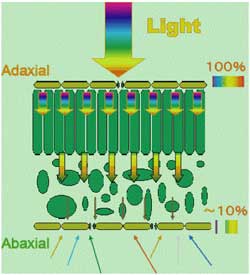
Stomata are microscopic pores on the leaf surfaces. They provide the major way to exchange CO2 and water between the ambient atmosphere and the plant, which is one of the most important processes for plant photosynthesis. Stomata respond to many environmental factors. Among them, humidity, intercellular CO2 concentration, and light are most important.
For the most amphistomatous leaves, stomata on the upper surface and those on the lower surface are in different light environments in terms of intensity as well as the wavelength composition. Thus we can expect that responses to light are different between the adaxial and abaxial stomata of the same leaf. Although many in vitro studies showed some difference between the adaxial and abaxial stomata, there were few studies illustrating differences in responses of these stomata to light environment in intact leaves
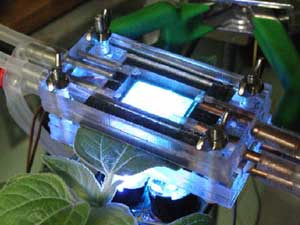
In this study, a new system was set up to measure the each side of stomatal conductance and photosynthetic CO2 exchange separately and simultaneously. Intact leaves of sunflower (Helianthus annuus cv. Russian Giant) were used to investigate differences in light response between the adaxial and abaxial stomatal conductances
To the top of this page
Back to Lab members page